The MAA club is hosting its first event: an origami night on Thursday September 23rd, from 4-6pm in Olin 372. Come on by for origami and snacks! All students are welcome, math majors or not.
You can click this link to add the event to your calendar!
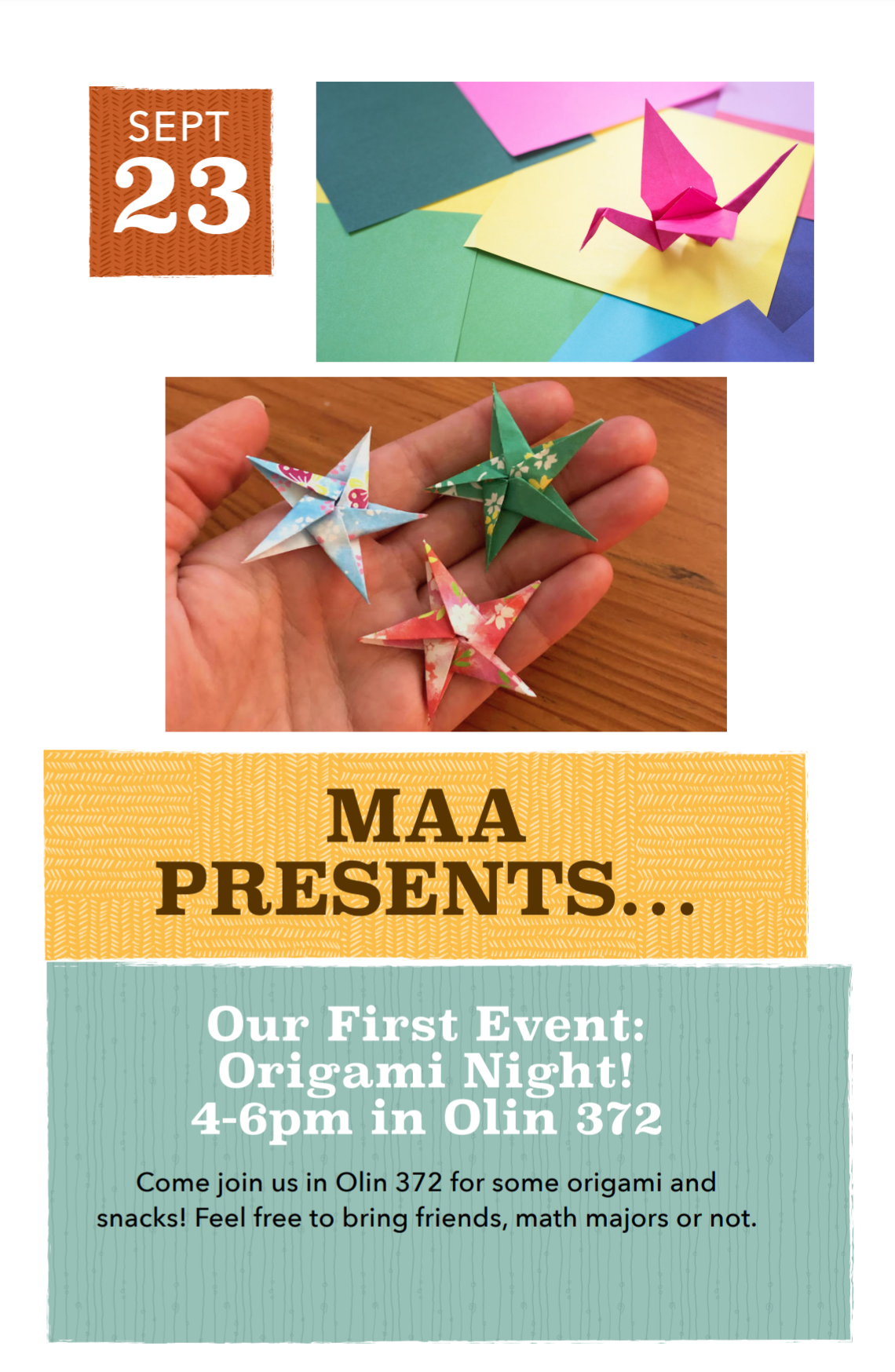
The MAA club is hosting its first event: an origami night on Thursday September 23rd, from 4-6pm in Olin 372. Come on by for origami and snacks! All students are welcome, math majors or not.
You can click this link to add the event to your calendar!
Presented by
Thiago Serra
Department of Analytics and Operations Management
School of Management – Bucknell University
Thursday, September 16
Abstract: Neural networks have been successfully applied to complex predictive modeling tasks in areas such as computer vision and natural language processing. On the one hand, they have been shown to be a very powerful mathematical modeling tool. On the other hand, we may still need an unreasonably large neural network in order to obtain a predictive model with good accuracy in many cases. How can we reconcile those two facts?
Pizza served at 11:40 in terrace Holmes 327.
Student Colloquium Talk by Professor Jen Berg.
Abstract: Have you ever wondered about ways to divide cake, chores, or rent among your friends fairly? There are many mathematical notions of fairness for you to consider! In this talk, we’ll explore an envy-free division, that is, one in which each person feels they received the best share. In particular, this means no person will want anyone else’s share more than their own. Better still, the approach we’ll discuss is algorithmic, or comes with a set of steps you can always follow, to help ensure you feel your slice is right!
Pizza will be provided outside of Dana 113 at 11:40am, the talk will start at 12:10pm!

Bucknell’s 1st Mathy Art Contest. Mathematics and art go together like chips and salsa, Beyoncé and Jay-Z, and orange and blue. If you agree, enter this contest! If you disagree, let us prove you wrong!
• All forms of art welcome including drawing, painting, coloring, sculpture, origami, poetry, creative writing, and the performing arts.
• Only requirement: your submission has some mathematical element, anything from a simple pattern to an Escher-esque hyperbolic plane.
• All members of the broader Bucknell community are welcome to contribute, including local residents, children of Bucknellians, etc.
• Winners in various categories will be by popular vote of the community at a future event. Prizes: eiπ+1 plus great acclaim.
• Deadline: Labor Day, September 6. Send your submissions to peter.mcnamara@bucknell.edu or drop off in Olin 380.
Poster: http://www.unix.bucknell.edu/~pm040/mathy-art-contest-poster.pdf
Come say hello to Math. Dept. faculty & meet fellow students
Play outdoor games & pick up a welcome back pack
Rain date Tues. Aug. 31, 4:00-5:30
The Mathematics Department Virtual Student Colloquium Series will present talks by Bucknell Students Thursday, November 12 at 12:30 PM on Zoom! Students will discuss “What Did You do Last Summer?”
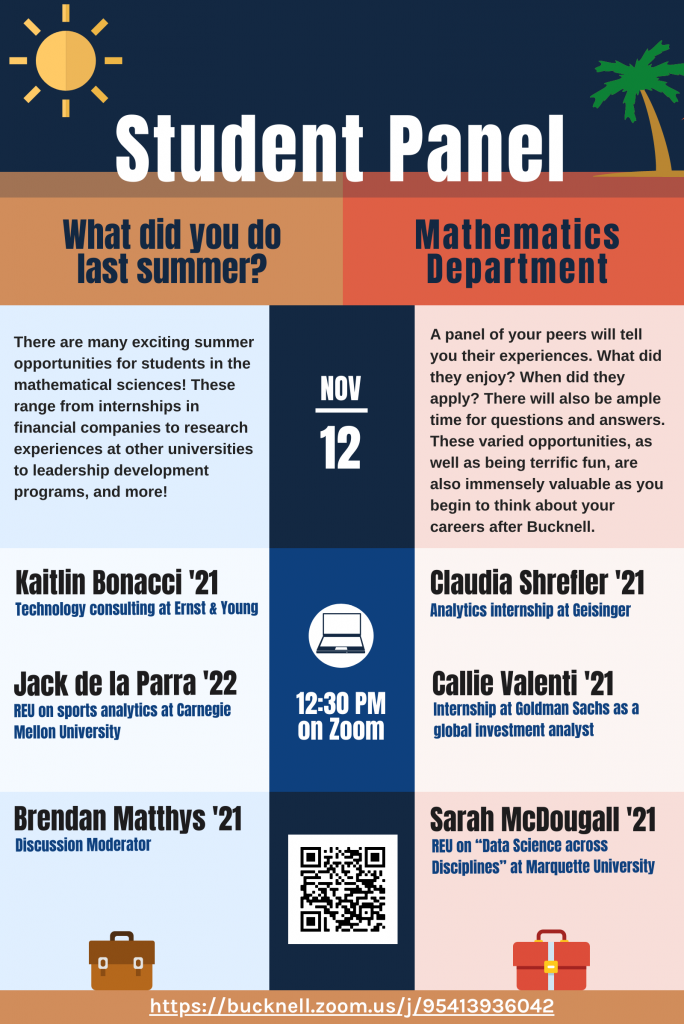
The panel will feature
Abstract: There are many exciting summer opportunities for students in the mathematical sciences! These range from internships in financial companies, to research experiences at other universities, to leadership development programs, and more! A panel of your peers will tell you their experiences. What did they enjoy? When did they apply? There will also be ample time for questions and answers. These varied opportunities, as well as being terrific fun, are also immensely valuable as you begin to think about your careers after Bucknell!
Zoom Link: https://bucknell.zoom.us/j/95413936042
Video: https://mediaspace.bucknell.edu/media/1_77a53jhz (Bucknell login required)
Slides:
All the panelists shared their contact details for those with follow-up questions:
https://bucknell.zoom.us/j/95413936042
Student Colloquium Talk by Professor Sanjay Dharmavaram
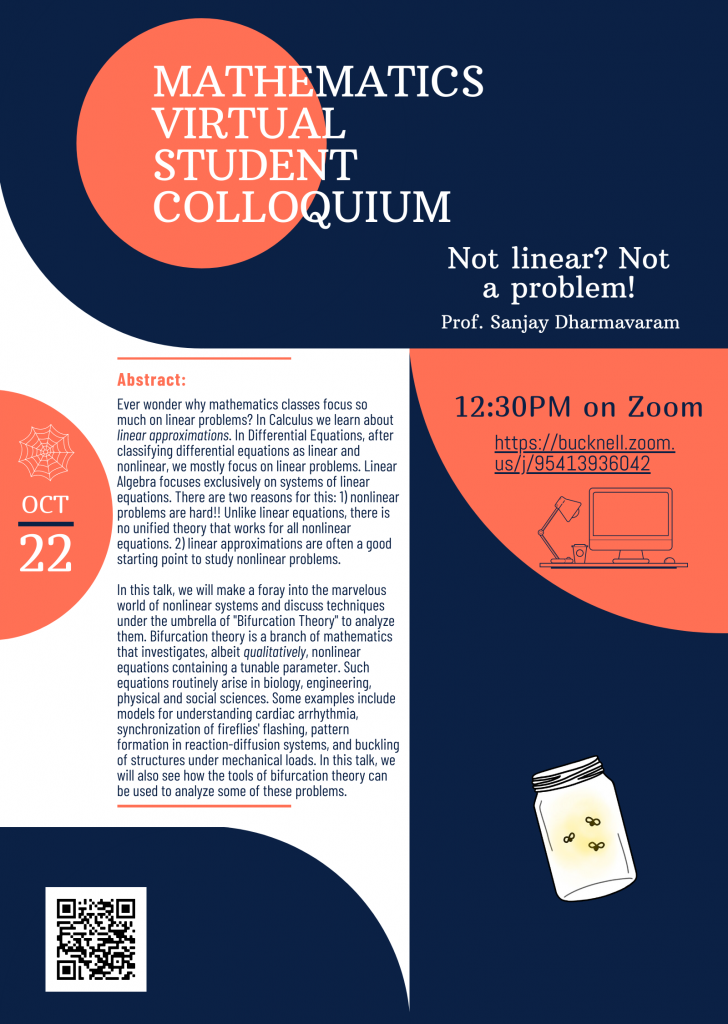
Abstract: Ever wonder why mathematics classes focus so much on linear problems? In Calculus we learn about linear approximations. In Differential Equations, after classifying differential equations as linear and nonlinear, we mostly focus on linear problems. Linear Algebra focuses exclusively on systems of linear equations. There are two reasons for this: 1) nonlinear problems are hard!! Unlike linear equations, there is no unified theory that works for all nonlinear equations. 2) linear approximations are often a good starting point to study nonlinear problems.
In this talk, we will make a foray into the marvelous world of nonlinear systems and discuss techniques under the umbrella of “Bifurcation Theory” to analyze them. Bifurcation theory is a branch of mathematics that investigates, albeit qualitatively, nonlinear equations containing a tunable parameter. Such equations routinely arise in biology, engineering, physical and social sciences. Some examples include models for understanding cardiac arrhythmia, synchronization of fireflies’ flashing, pattern formation in reaction-diffusion systems, and buckling of structures under mechanical loads. In this talk, we will also see how the tools of bifurcation theory can be used to analyze some of these problems.
Watch on Mediaspace: https://mediaspace.bucknell.edu/media/1_gzca3xpq
Student Colloquium Talk by Professor Michael Reeks.
Abstract:
Anyone who has ever shoved a pair of headphones in their pocket knows about the following general principle of the universe:”Any flexible strand will tie itself in knots as soon as it’s given the opportunity.” As such, knots are ubiquitous in nature and art:
– DNA strands, so often pictured as tidy helices, actually spend most of their time hopelessly knotted;
– the way in which proteins interact and function depends heavily on the way they are folded, or knotted, together;
– and some of the oldest known art is based on complex patterns of knots.
Mathematicians, always ready to help out, have therefore tried to study and classify knots for decades. In this sadly pizza-less talk, I’ll introduce the mathematical theory of knots and knot invariants, which are tools that can help us tell knots apart. I’ll explain how some basic questions in knot theory tie into sophisticated topics of current research, and explain a few fascinating ways in which knots arise in chemistry, biology, physics, and art.
Flyer: https://tinyurl.com/y4fwvzjh
Video (Bucknell login required): https://mediaspace.bucknell.edu/channel/Mathematics%2BDepartment/184494973

Student Colloquium Talk by Professor Allison Lewis, Lafayette College
Abstract: How can mathematical modeling assist in the development of treatment protocols for cancer? Recent technological advances make it possible to collect detailed information about tumors, and yet clinical assessments of treatment responses are typically based on extremely sparse datasets. We propose a workflow for choosing an appropriate model for tumor growth and treatment response, verifying parameter identifiability, and assessing the amount of data necessary to precisely calibrate model parameters in order to make accurate predictions of tumor size at future times. Throughout this talk, we will discuss ways in which we can bridge the gap between mathematical modelers and clinical physicians to better harness the power of both worlds to meet a common goal.
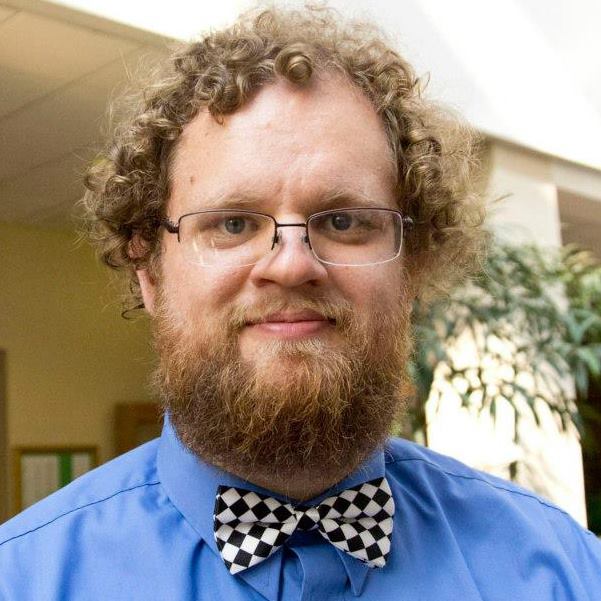
Student Colloquium Talk by Professor Kenny Barrese, Bucknell University
Abstract: Rook theory is a branch of mathematics which considers how many ways you can put rooks on a board so that no two are attacking each other. Here a “rook” is the usual chess piece, but the “board” that we are placing on probably is not an eight by eight square. One way to consider the numbers you obtain is as coefficients of a polynomial, the rook polynomial. It is a key result in rook theory that, if you define the rook polynomial correctly, it always factors completely! In fact, we will see that this factorization arises not by algebraic manipulation, but by counting things in a clever way.