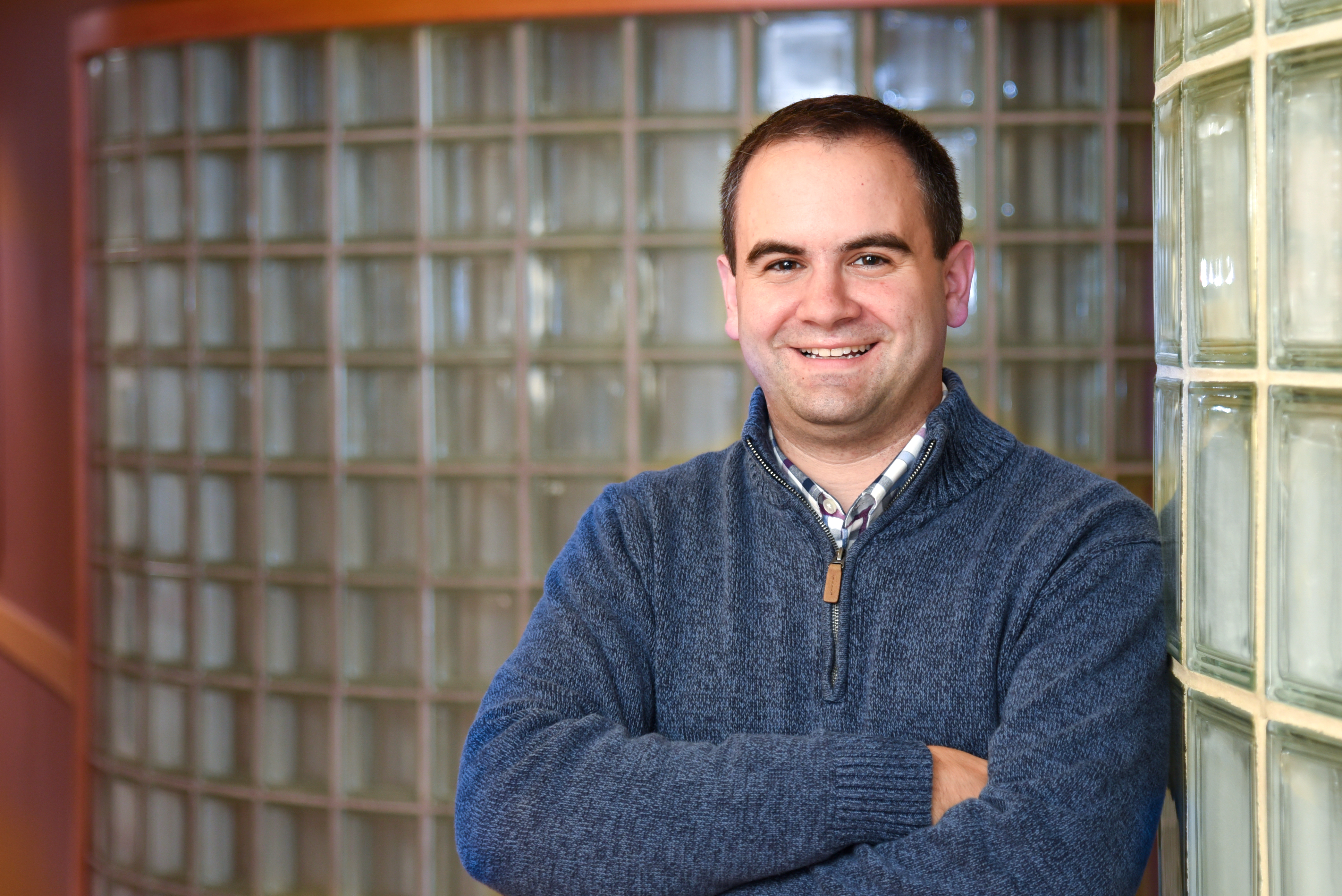
“Using Genetic Algorithms for U.S. Army Robot Design” at noon on Thursday 2/14 in Olin 268

Student Colloquium talk by Professor Lucas Waddell of Bucknell University

Title: Using Genetic Algorithms for U.S. Army Robot Design

Abstract: In recent years, Operations Research practitioners have increasingly utilized nature-inspired algorithms (NIAs) to solve real-world, large-scale optimization problems. One of the most popular NIAs is the Genetic Algorithm (GA), which is based on ideas from Darwin’s theory of evolution. This talk will provide an introduction to GAs through the lens of a project that Lucas worked on for the U.S. Army during his time as an Operations Research Analyst at Sandia National Laboratories.

Sports, Statistics and Society

As part of Professor Flynt’s Foundation Seminar titled Sports, Statistics and Societygroups of first-year students acted as consultants, performing sports analytics for different Bucknell athletic teams.  Students worked with Baseball, Field Hockey, Men’s and Women’s Basketball, and Football.  Each coach developed a set of questions that they were interested in having the students analyze and gave students full access to their team data.   The group of students working with the football team worked very closely with Offensive Coordinator, Coach Bobby Acosta, spending time in the football coaching suite, looking at game video, and taking stats for the team up in the box at several practices.  Their analysis of practice data helped inform play calling for the offense in the last couple games of the season.  The project was featured in this segment during the TV broadcast of the final game versus Fordham on November 17th.

“What Did You Do Last Summer?” at noon on Thursday 11/1 in Olin 268

Student Colloquium talk presented by Bucknell Students

Moderator: Nate Mattis ’19

Presenters:

  • Hannah Bokma ’20, Teaching Experience for Undergraduates, Brown University
  • Nate Lesnevich ’19, Undergraduate Research (Pure Mathematics), Bucknell University
  • Christina Sweeney ’19, Data Analytics, Slalom Consulting
  • Xeniya Tsoktoyeva ’19, Finance, PNC Bank
  • Yili Wang ’21, Undergraduate Research (Applied Mathematics), Bucknell University

Abstract: There are many exciting summer opportunities for students in the mathematical sciences! These range from internships with financial companies to research experiences at other universities to leadership development programs. In this week’s colloquium, a panel of your peers will tell you their experiences. What did they enjoy about their experiences? When did they apply? There will also be ample time for questions and answers. These varied opportunities, as well as being terrific fun, are also immensely valuable as you begin to think about your careers after Bucknell.

Assigning Students to Schools to Minimize Socioeconomic Variation between Schools: An Introduction to Optimization Modeling at noon on Thursday 10/18 in Olin 268

Student Colloquium talk by Professor Dick Forrester of Dickinson College

Title: Assigning Students to Schools to Minimize Socioeconomic Variation between Schools: An Introduction to Optimization Modeling

Abstract: Numerous studies have found that a student’s academic achievement is as much determined by the socioeconomic composition of their school as their own socioeconomic status. In this talk we provide a methodology for assigning students to schools so as to balance the socioeconomic compositions of the schools while taking into consideration the total travel distance. Our technique utilizes a bi-objective general 0-1 fractional program that is linearized into a mixed 0-1 linear program which can be submitted directly to a standard optimization package. If you didn’t understand that last sentence, don’t worry, the purpose of this talk is to introduce you to optimization modeling.  As a test case for our approach we analyze data from the Greenville County School District in Greenville, South Carolina.

Listening to Orbifolds and Orbigraphs at noon on Thursday 10/4 in Olin 268

Student Colloquium talk by Professor Liz Stanhope of Lewis and Clark College (Visiting Professor at Bucknell University)

Title: Listening to Orbifolds and Orbigraphs

Abstract: Spectral geometry is a lively area of mathematical research motivated by the question `Can you hear the shape of a drum?’ My work in spectral geometry has been to study the spectral properties of objects called orbifolds.  Questions in spectral geometry have useful analogs in graph theory.  Because of this we’ll discuss how to make sense of the concept of orbifold in the setting of spectral graph theory.

Bioinformatics and the Challenges of Visualizing Big Data at noon on Thursday 9/20 in Olin 268

Student Colloquium talk by Professor Ken Field of Bucknell University

Title: Bioinformatics and the Challenges of Visualizing Big Data

Abstract: Bioinformatics and next generation sequencing have revolutionized biology and medicine. The increasing affordability of next generation sequencing has made it possible to use whole-genome and whole-transcriptome approaches to answer questions in the lab, the field, and the clinic. However, working with these large datasets presents several computational and statistical challenges. As an example, we will discuss the importance of data exploration and multiple testing corrections. In addition, visualizing complex multi-dimensional data is also difficult and we will discuss approaches using interactive data displays and virtual reality.

Proofs Without Witnesses: Zero Knowledge Proofs at noon on Thursday 9/6 in Olin 268

Title:  Proofs Without Witnesses: Zero Knowledge Proofs

Abstract:  Peggy wants to convince Victor that she possesses a secret. Victor doesn’t believe that Peggy is telling the truth while Peggy doesn’t trust Victor enough to show him the secret. Zero knowledge proofs provide a method by which Peggy can convince Victor that she has the secret without giving Victor any information about the secret itself. In this talk we’ll construct and analyze several zero knowledge proofs, and discuss how they can be used in a wide array of areas including computer security and nuclear disarmament.

Dynamical Systems and Fixed Points at noon on April 12 in Olin 268

Student Colloquium talk by Professor Aimee Johnson of Swarthmore College

Abstract:  We all wish we could see into the future!  In dynamical systems, we formalize what this might mean and explore to what extent it might be done.  One useful tool in this task is to investigate the fixed points of the system.  In this talk, we will explore three different examples of dynamical systems, find the fixed points for each one, and then see how they can help us learn about other points in the system.  In this way, we can try to tell a little bit about the future (at least for these examples!).

Mathematics & Social Justice at noon on March 29 in Olin 268

Karen Saxe, Director of Government Relations for the American Mathematical Society and DeWitt Wallace Professor of Mathematics at Macalester College


Abstract:  Societal inequalities pose some of the biggest and most intractable challenges facing our nation today. Can mathematical concepts help us understand and analyze social inequality? What is the relationship between various imbalances in the U.S. today such as those we see in income distribution and political polarization? Many say that gerrymandering contributes to political polarization; can we use a quantitative strategy to determine the validity of this assertion? This talk will focus on quantitative approaches that mathematicians and political scientists use to measure social inequalities and fairness in redistricting. I will also discuss my advocacy work for the American Mathematical Society, and we’ll have plenty of time for Q & A. No mathematical background required.

“The Mathematics of Uncertainty” March 22 at 7pm in Trout Auditorium

Graciela Chichilnisky, lead architect of the carbon market of the Kyoto Protocol and a professor of economics and mathematical statistics at Columbia University, will give the keynote presentation for the 2018 Sustainability Symposium on Thursday, March 22, at 7 p.m. in Leanne Freas Trout Auditorium. Bucknell President John Bravman will introduce Chichilnisky, who also contributed to reports of the Intergovernmental Panel on Climate Change (IPCC), the organization that shared the 2007 Nobel Peace Prize with Al Gore, “for their efforts to build up and disseminate greater knowledge about man-made climate change, and to lay the foundations for the measures that are needed to counteract such change.”