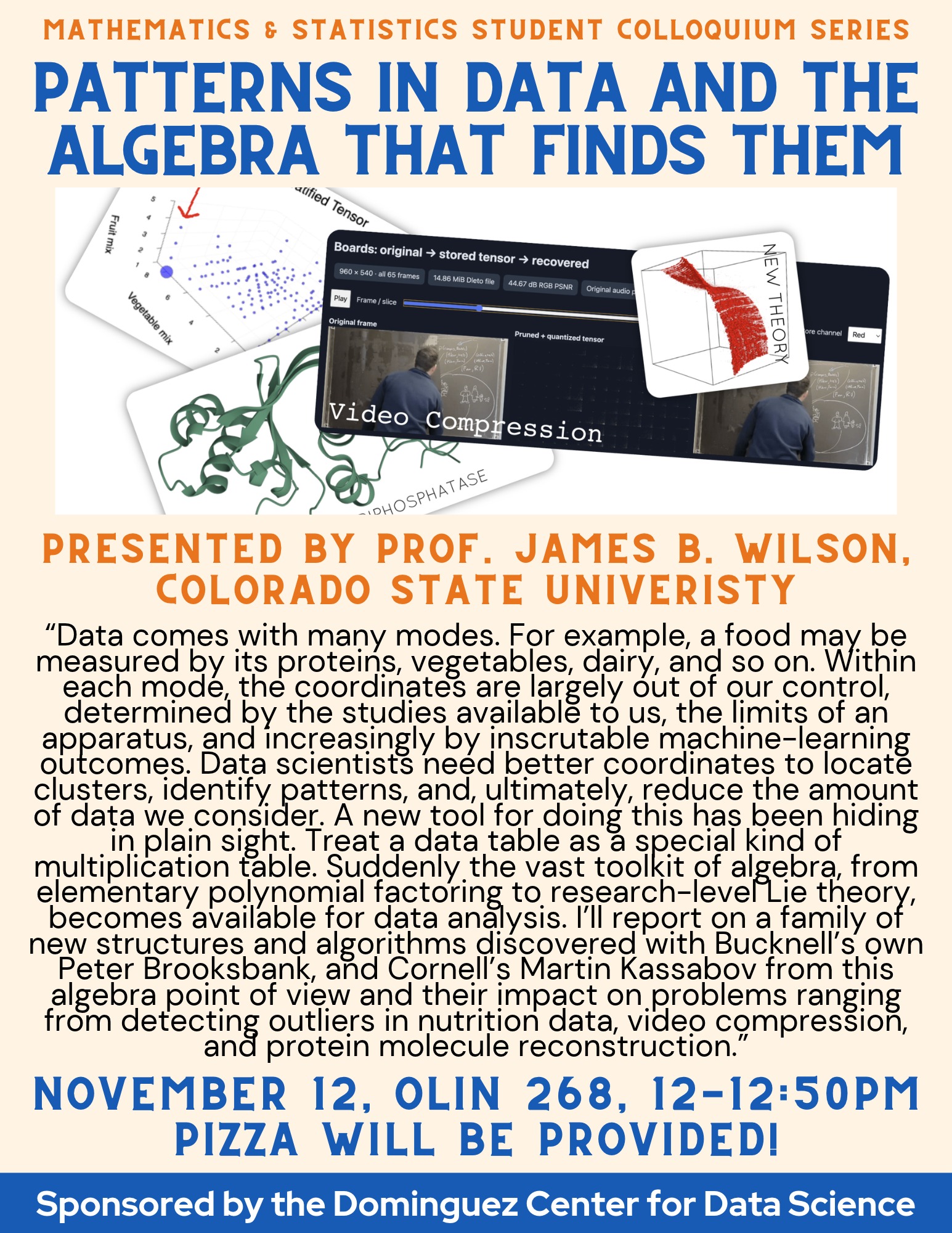
Colloquium Title: Patterns in Data and the Algebra That Finds Them
Follow along with the slides here.
Abstract: Data comes with many modes. For example, a food may be measured by its proteins, vegetables, dairy, and so on. Within each mode, the coordinates are largely out of our control, determined by the studies available to us, the limits of an apparatus, and increasingly by inscrutable machine-learning outcomes. Data scientists need better coordinates to locate clusters, identify patterns, and ultimately, reduce the amount of data we consider. A new tool for doing this has been hiding in plain sight. Treat a data table as a special kind of multiplication table. Suddenly the vast toolkit of algebra, from elementary polynomial factoring to research-level Lie theory, becomes available for data analysis. I’lll report on a family of new structures and algorithms discovered with Bucknell’s own Peter Brooksbank, and Cornell’s Martin Kassabov from this algebra point of view and their impact on problems ranging from detecting outliers in nutrition data, video compression, and protein molecule reconstruction.
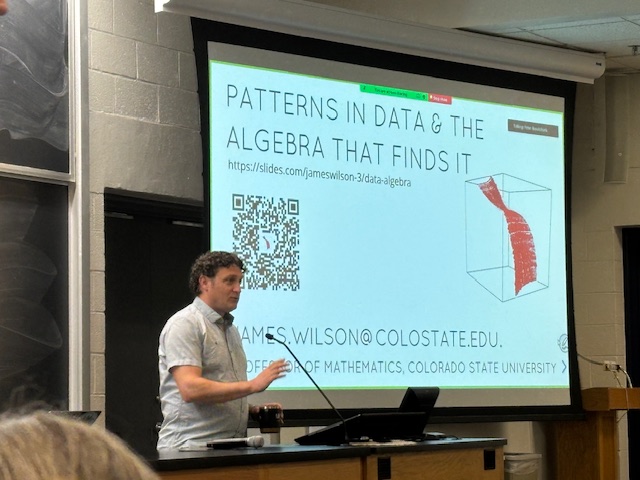
Current job: Professor of Mathematics at Colorado State University
Tell us about your journey to your current job.
As a kid I programmed odd electronic projects for local college students in my home country of Venezuela before coming to the US as a teen. Through the help of a high school teacher I got setup with an internship with Intel’s Architecture Labs where we were challenged to imagine the world of computers in 10-20 years, many of those concepts exist today as products from the Apple iPad, to Microsoft Sync, to Amazon’s Alexa. It convinced me that you can imagine a future and reach for it. Code came easy to me so I put my time into learning math and after a summer REU I quit coding for math. After grad school I taught for 3 years at the Ohio State University and was invited to join as adjunct for the Centers for Communication where I suddenly was back to coding but this time with more data and much more math. I am now a Mathematics Professor at Colorado State University, associate with the Data Science Research Institute, and I am still searching for that imaginary line between data, computation, and mathematics. I’m beginning to think they’re all the same thing.
Shout out a teacher or mentor that helped you along the way.
Chris Genly mentored me at Intel and Bill Kantor, Eugene Luks (former Bucknell Professor), and Charlie Wright mentored me through mathematics. Each one deserves a lifetime of my gratitude.
What first got you into the particular topic you will talk about in your talk?
I was speaking to an undergraduate at a conference and was amazed that I did not understand what he meant by a tensor. Me, a PhD professor, lost on something so standard? I was jazzed to learn how much of the world of data I had been ignoring. 15 years later this journey to discover continues to surprise me and my colleagues.
If students want to learn more about the topic in your talk, what resources do you recommend checking out?
HTTPS://TheTensor.Space, we have loads of videos and software from people from around the world ready for you to explore at whatever you level you want to investigate.
Where and when do you get your best work done? What does your working environment have to look/feel like to be productive?
On trips. I love being in a coffee shop in a foreign town or on a train to someplace different with by notebook out writing the same idea out one more time to see if I get further this time. And when I do, that location becomes forever the reason it was possible.
What is a class you really recommend students take and why? (It doesn’t have to be a math/stat class!)
Take one class that makes you different.
What general advice do you have for students?
Keep in touch with one good teacher for the rest of your life. It takes a long time for a teacher to know you well enough to give you actually good advice. But if you put in the time over a longer period, suddenly the insights they can share will be life changing for both of you.
What do you like to do for fun?
Travel! I like many local things too, but if you invite me to visit you somewhere I’ve never been I’m gonna find a way to say yes.