Perfectly Imperfect: Music, Math, and the Keybord Presented by Gloria Cheng, Grammy and Emmy award winning pianist Adjunct Professor, UCLA Herb Albert School of Music
Sponsored by the Departments of Music and Mathematics, with funding provided by the Kushell Music Endowment and the University Leadership Committee.
An introduction to aperiodic tilings Presented by Scott Schmieding, Assistant Professor of Mathematics, Penn State University
ABSTRACT: An aperiodic tiling is a pattern that, despite looking like it may repeat, never actually does. They have been a subject of considerable interest, especially in connection with materials called quasicrystals discovered in the 1980’s. In this talk we’ll give a light introduction to their mathematical structure, including how to construct some.
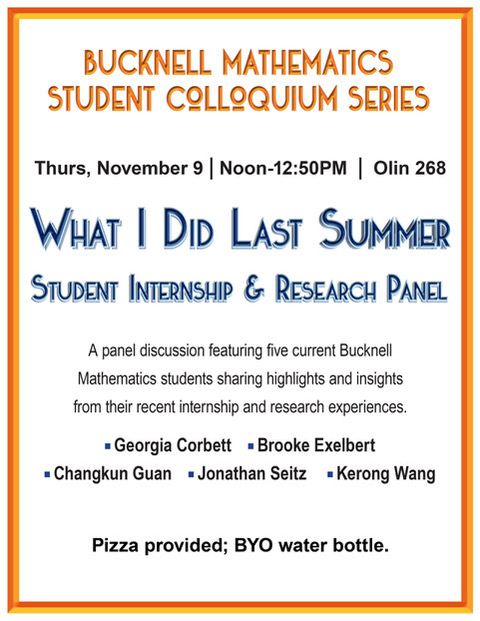
What I did last summer: student internship and research panel
A panel discussion featuring five current Bucknell Mathematics students sharing highlights and insights from their recent internship and research experiences.
Panelists: Georgia Corbett Brooke Exelbert Changkun Guan Jonathan Seitz Kerong Wang
Manipulation of thin flexible objects Presented by Andy Borum, Assistant Professor of Mathematics, Vassar College
ABSTRACT: The next time you tie your shoes, unravel a charging cable, or twirl a noodle around a fork, think about how this problem could be described mathematically. Here is one possible description (continuing with the noodle example)—given two shapes of a three-dimensional curve, one representing the noodle’s starting shape and one representing the goal shape, how should the curve’s endpoints be moved so that the curve deforms from the starting shape into the goal shape? During this process, we should avoid self-intersections of the curve, since the noodle can’t pass through itself, and ensure that the curve remains in stable equilibrium so that the noodle doesn’t slide off of the fork. These two constraints—avoiding self-intersections and remaining stable—make this problem seem particularly challenging. In this talk, I will describe an example of this problem from robotics—manipulation of a thin flexible cable—and I will show how a careful analysis of the equations describing the cable’s shape leads to a closed-form solution of this problem.
Featuring Bucknell Mathematics Alumni sharing their career paths, insights, and advice on post-Bucknell career planning.
Panelists: Elise Covert – IQVIA Biotech Hannah Jarosinski – Axtria Spandan Marasini – Institute on Taxation and Economic Policy Nate Mattis – Bermudian Springs High School Robert Rhoades – Susquehanna International Group
That’s So Random! Presented by Keegan Kang, Assistant Professor of Statistics, Bucknell University
ABSTRACT: Think of a large number N. Now imagine you and your friends each picking a random number between 0 and N. Can these random numbers be used meaningfully? Surprisingly, yes! We will discuss how we can use statistics to get an approximation to computationally difficult problems, and show how such randomness can be used in web search and plagiarism detection.
The AfterMath of an Extreme Natural Event presented by Linda Smolka, Professor of Mathematics, Bucknell University
ABSTRACT: An astonishing thing happened on January 15, 2022. The Hunga Tonga-Hunga Ha’apai submarine volcano located in the South Pacific Ocean erupted, becoming the largest volcanic eruption in the modern satellite era on a scale not observed since Krakatoa erupted in 1883. The eruption was so powerful that among the shock waves it generated, the largest traversed the globe multiple times over several days. We’ll focus on the mathematics to model and understand this shock wave and also recount other extraordinary phenomena in the eruption’s aftermath. Curious where calculus is used in the real-world? Come see.
BUCKNELL MATHEMATICS STUDENT COLLOQUIUM SERIES Thurs, October 27 | Noon-12:50PM | Olin 268 What did you do last summer?
Moderated by Kelly Karpovich (2 internships: Complete Actuarial Solutions Company and The Talent Studios) with panelists
Lizzi Bianchine (internship @ Johnson and Johnson)
Georgia Corbett (research @Bucknell w/ Professor Bickel)
Jack Joseph (internship @ Pepsi)
Michael Perez Palapa (REU)
ABSTRACT: There are many exciting summer opportunities for students in the mathematical sciences! These range from internships in financial companies to research experiences at other universities to leadership development programs. In this week’s colloquium, a panel of your peers will tell you their experiences. What did they enjoy about their experiences? When did they apply? There will also be ample time for questions and answers. These varied opportunities, as well as being terrific fun, are also immensely valuable as you begin to think about your careers after Bucknell.
Andy Lee, Bucknell ’99, will speak on his path from a degree in Physics to a career in Finance and how his undergraduate training influences his current work, including: the analysis that he works on and how it relates to physics/math (the system and the methods like Monte Carlo simulations); and how he gets from the analytics to financial decisions (fairly high level).
Open to all students and faculty; pizza will be provided…please bring your own water.
Using Maths to Save The World presented by Helen Greatrex, Professor of Geography and Statistics, Penn State University
ABSTRACT: Droughts kill thousands of people each year, especially in countries like Somalia where there is conflict and very little water to start off with. Humanitarian experts often have to decide which places need the most help and alongside working with local communities, they also have to know how much rain has fallen. But how do you map rainfall in places where it’s too dangerous to gather data from weather-stations? Or in the vast spaces where we don’t have any weather stations at all? We turn to satellites! In this colloquium, we will chat about how simple mathematics can turn “space-photos” into useful weather information, and what happens when different satellites disagree… Arrive early for free pizza!